
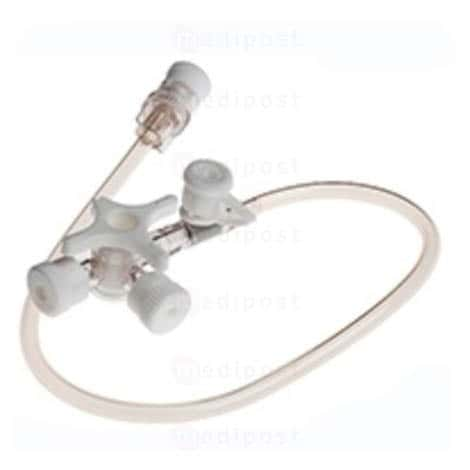


3-Way Stopcock with 100cm Extension Connecta Plus
The Connecta Plus 3-way stopcock with 100 cm extension facilitates access to hard-to-reach peripheral catheters. This sterile single-use device, DEHP-free and lipid-resistant, allows infusion line connections and bolus injections. Its visual click system confirms position, while its two anti-tightening teeth prevent cracking risks.
| Brand: BD Becton Dickinson |

Référence |
394961 |
Associated categories: Injection and infusion equipment > Infusion stopcocks > 3-way stopcock with 100cm extension Connecta Plus
Features
- Medical 3-way stopcock with integrated 100 cm extension
- Sterile single-use device
- DEHP-free extension for better biocompatibility
- Seal guaranteed up to pressures exceeding 3 bars
- Reduced dead volume: 0.23 ml
- Distal line flow rate: 660 ml/min.
- Lateral line flow rate: 480 ml/min.
- Open/closed click for visual confirmation of stopcock position
- Lipid-resistant material compatible with lipid emulsions
- 2-tooth system preventing over-tightening and reducing risk of cracking
- Suitable for difficult-to-access peripheral catheters
- Compatible with intravenous therapies and haemodynamic monitoring
- Available individually or in a box of 20 pieces
Often bought together
A 100 cm extension that finally makes access to the most distant catheters easier, without compromising on seal integrity.
Frequently asked questions
Why choose a DEHP-free extension for infusions?
DEHP is a potentially harmful plasticizer that can migrate into infused solutions, particularly lipid emulsions. A DEHP-free extension guarantees better patient safety, especially during prolonged infusions.
How do you know if the 3-way stopcock is in the open or closed position?
The Connecta Plus stopcock is equipped with a click system that clearly indicates the open or closed position. This tactile and visual confirmation allows you to quickly verify the stopcock status without risk of error.
What is the difference in flow rate between the distal and lateral lines?
The distal line offers a flow rate of 660 ml/min while the lateral line allows a flow rate of 480 ml/min. This difference is explained by the configuration of the internal channels and must be taken into account when administering high-flow infusions.