
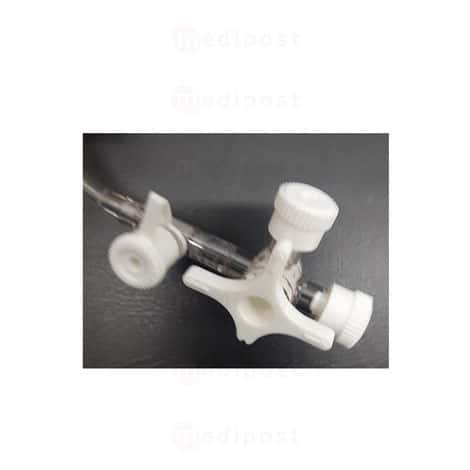


3-Way Stopcock with 100cm Extension + Injection Site
The 3-way stopcock with 100 cm extension and injection site is a sterile single-use medical device, ideal for hard-to-reach peripheral catheters. DEHP-free and lipid-resistant, it allows extemporaneous injections and infusion line connections with sealing superior to 3 bars.
| Brand: BD Becton Dickinson |

Référence |
394971 |
Associated categories: Injection and infusion equipment > Infusion stopcocks > 3-way stopcock with 100cm extension + injection site
Features
- Medical 3-way stopcock with integrated 100 cm extension and injection site
- Sterile and single-use device
- Extension without DEHP (phthalate-free)
- Injection site for direct needleless syringe connection
- Lipid-resistant for compatibility with lipid emulsions
- Leak-proof seal guaranteed up to pressures exceeding 3 bars
- Reduced dead volume: 0.23 ml
- Distal line flow rate: 660 ml/min.
- Lateral line flow rate: 480 ml/min.
- Positioning notch clearly indicating open/closed state
- 2-tooth system limiting excessive tightening to prevent cracking risks
- Suitable for difficult-to-access peripheral catheters
- Compatible with intravenous therapies and hemodynamic monitoring
- Available as single unit or box of 20 pieces
The ideal length to reach the most distant catheters without compromising injection safety.
Frequently asked questions
Why choose a DEHP-free extension for infusions?
DEHP is a plasticizer that can migrate into infused solutions, particularly lipid emulsions. A DEHP-free extension guarantees better patient safety by eliminating this contamination risk, which is particularly important in parenteral nutrition or neonatology.
How to use the injection site of this 3-way stopcock?
The injection site allows you to directly connect a needleless syringe to perform extemporaneous injections or medicinal boluses. Simply insert the syringe tip into the designated site without requiring additional manipulation of the infusion line.
What is the difference between distal and lateral line flow rates?
The distal line offers a higher flow rate of 660 ml/min because it is in the main axis of the flow. The lateral line, with a flow rate of 480 ml/min, has slight resistance due to the connection angle. Both flow rates remain suitable for current infusion therapy needs.