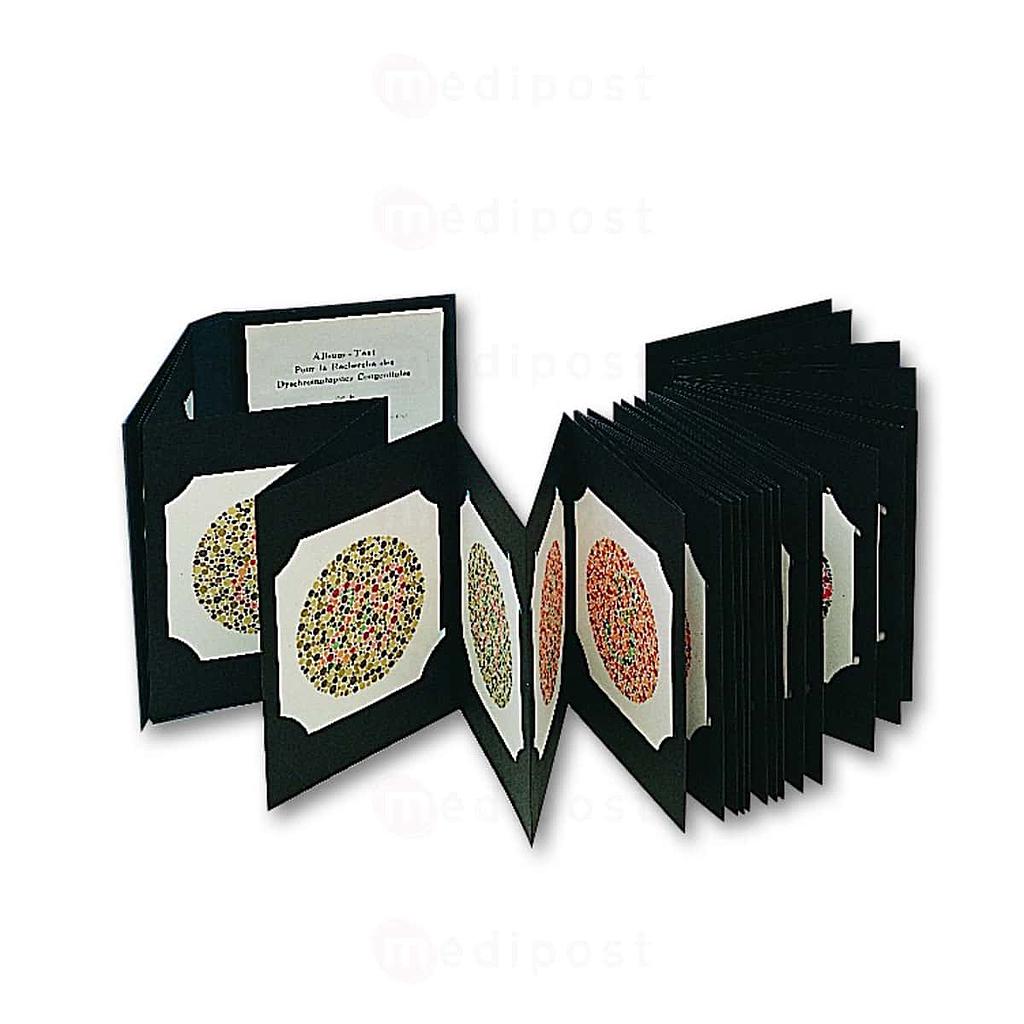
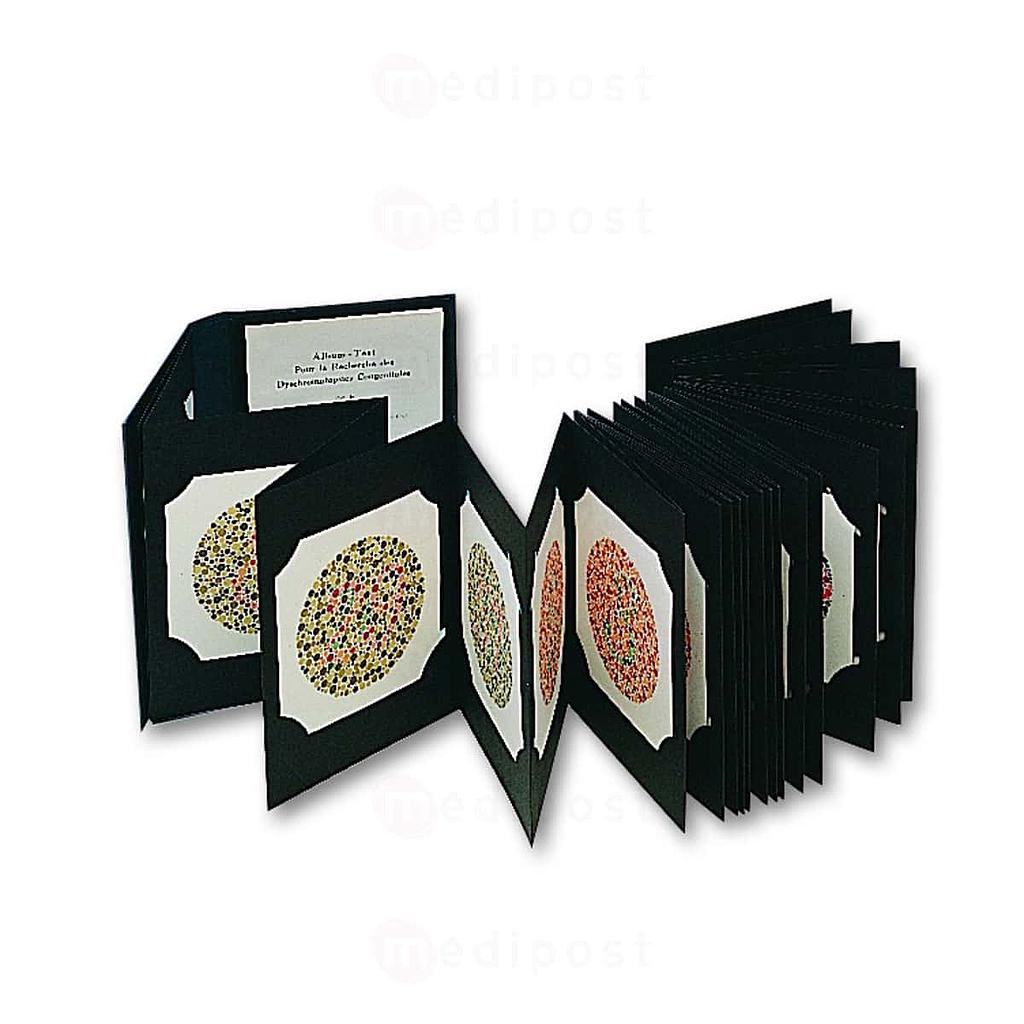

Ishihara Color Vision Test 24 Plates
The Ishihara 24 plate test enables rapid and reliable screening of colour vision disorders. Composed of 24 illustrated plates with numbers and coloured circles, this ophthalmological examination effectively detects dyschromatopsias, protanomalies and deuteranomalies. Recommended use at 70 cm, perpendicular to the patient's visual axis.
Référence |
1017128 |
Associated categories: Specialized diagnostic equipment > Optometric tests > Ishihara 24 plate color test
```htmlFeatures
- Screening test for color vision disorders
- 24 pseudoisochromatic plates
- Detection of red-green dyschromatopsia
- Identification of protanomalies (red deficiency)
- Identification of deuteranomalies (green deficiency)
- Plates composed of numbers surrounded by small colored circles
- Recommended viewing distance: 70 cm
- Perpendicular positioning to the patient's visual axis
- Quick and non-invasive test
- International reference method for colorblindness screening
- Suitable for medical, ophthalmology and occupational health practices
An essential screening tool to quickly identify color perception abnormalities.
Frequently asked questions
How to interpret results of the Ishihara 24 plate test?
The patient must identify the numbers hidden in each plate. A person with normal color vision distinguishes all the numbers, while a person with colorblindness may perceive some differently or not at all. The number and type of errors help determine the nature of the anomaly.
What is the difference between protanomaly and deuteranomaly?
Protanomaly corresponds to a deficiency in red color perception, while deuteranomaly concerns a deficiency in green color perception. Both anomalies are part of red-green dyschromatopsia and are the most common forms of colorblindness.
Under what conditions should the Ishihara test be performed for reliable results?
The test should be performed under natural light or standardized white light. The plates must be presented at 70 cm from the patient, perpendicular to their visual axis. Each plate is displayed for approximately 3 to 5 seconds for a spontaneous response.