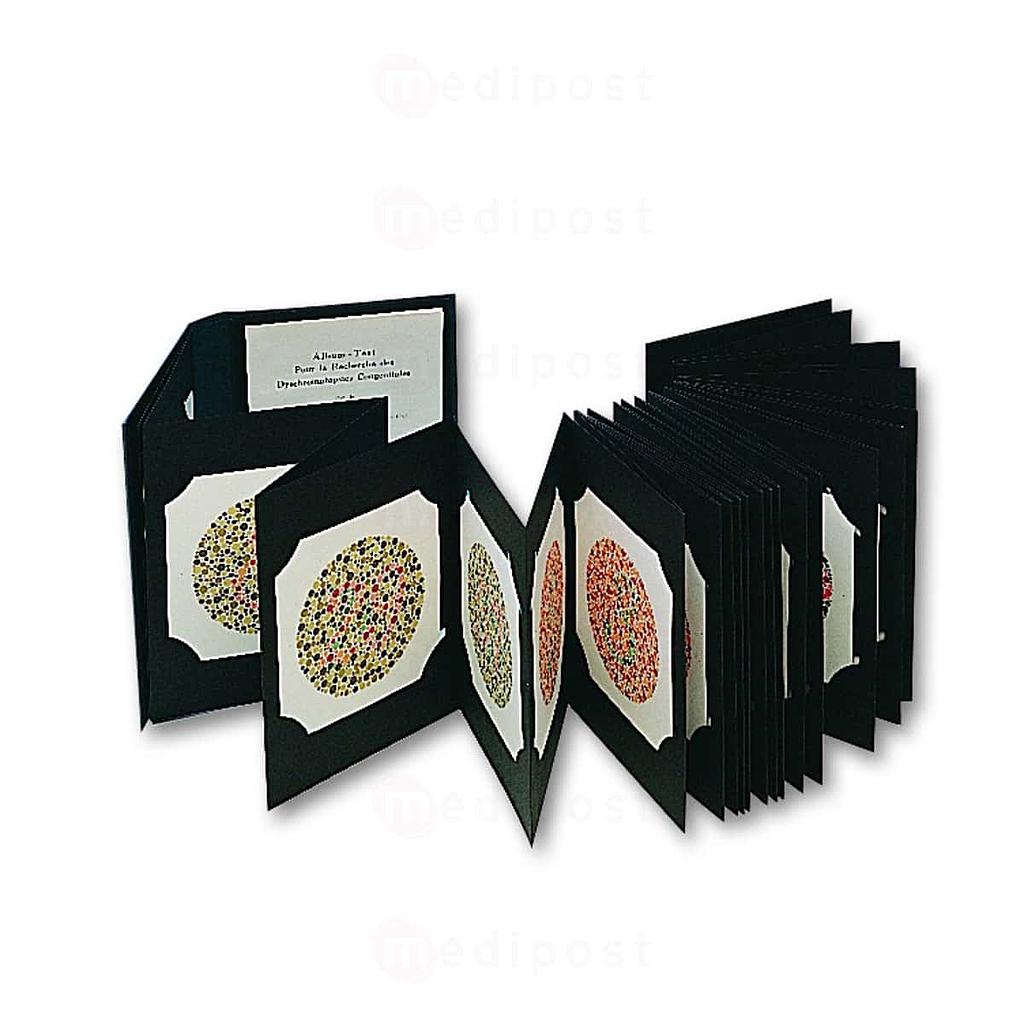

Ishihara colour blindness test 38 plates
The 38-plate Ishihara test is a recognized ophthalmological screening tool for quickly identifying colour vision disorders. Composed of illustrated plates with numbers and coloured circles, this colour test makes it possible to detect dyschromatopsias, in particular red perception anomalies (protanomaly) and green perception anomalies (deuteranomaly).
| Brand: Comed |

Référence |
9311159 |
Associated categories: Specialized diagnostic equipment > Optometric tests > Ishihara color test 38 plates
Features
- Ishihara color vision test with 38 plates
- Screening tool for dyschromatopsias (color perception disorders)
- Detection of protanomalies (red perception deficiency)
- Detection of deuteranomalies (green perception deficiency)
- 38 plates with numbers and small colored dots.
- Pseudoisochromatic method recognized worldwide
- Recommended viewing distance: 70 cm
- Perpendicular positioning to patient's visual axis
- Quick and non-invasive test
- Suitable for ophthalmology, optometry and occupational health practices
- Used for health examinations, driving license and occupational fitness assessments
Often bought together
An essential classic for reliable color blindness screening in just a few minutes.
Frequently asked questions
How do you interpret the results of the Ishihara 38 plate test?
Each plate displays a number visible only to people with normal color vision. If the patient fails to identify certain numbers or sees different ones instead, this indicates a color perception abnormality. The number and type of errors help determine the nature of the disorder.
What is the difference between the 24-plate and 38-plate Ishihara test?
The 38-plate version provides a more comprehensive and accurate assessment of dyschromatopsias. It includes additional plates allowing better differentiation of anomaly types and refinement of diagnosis between protanomaly and deuteranomaly.
Can the Ishihara test detect all types of color blindness?
The Ishihara test is designed to screen for red-green deficiencies, which represent the vast majority of color blindness cases. It cannot detect tritanopias (blue-yellow deficiency), which are much rarer and require other specific tests.