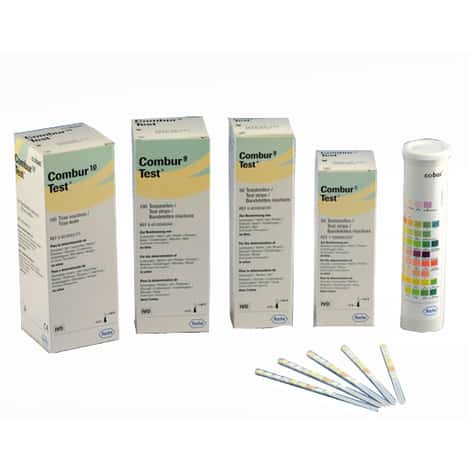
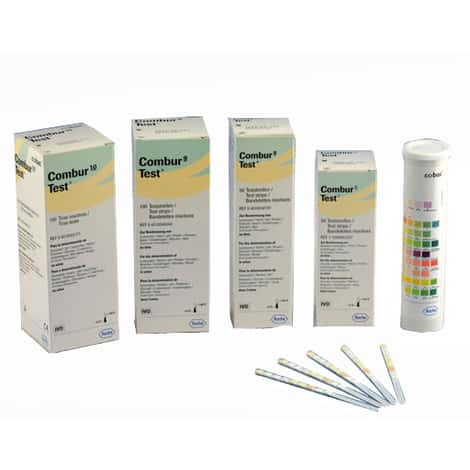
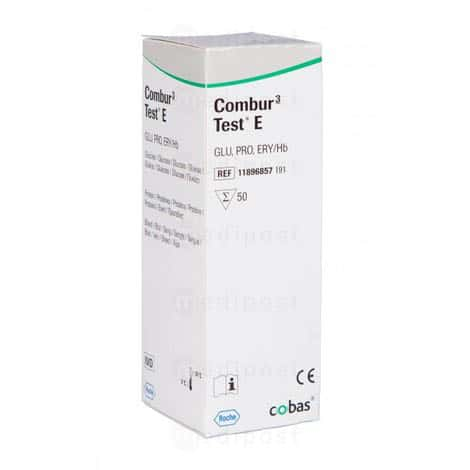
Combur-Test® urine test strips
Their specific structure prevents mixing of reagents from different test areas. Combur test strips are highly sensitive and react to the slightest pathological change, allowing for very precise diagnosis.
| Brand: Roche |

Référence |
1893467 |
Associated categories: Diagnostic testing equipment > Urine tests > Combur-Test® urine test strips
Features
-
Urine test strips
-
Combur tests are used for screening and monitoring kidney, urinary and metabolic diseases.
-
They are designed to be easy to use and offer fast and reliable results.
-
They are compatible with Urisys 1100 and Cobas urine readers.
-
They are equipped with a fading prevention technology to ensure accurate results.
-
They are designed to minimize vitamin C interference, which can distort the results of certain urine tests
-
Ability to read all results from different reactive zones simultaneously.
-
Only a single test strip is needed to test many parameters.
Often bought together
Parameters:
- Combur 10: Glucose, protein, pH, nitrites, ketones, urobilinogen, bilirubin, blood, leukocytes, urine specific gravity.
- Combur 9: Glucose, protein, pH, nitrites, ketones, urobilinogen, bilirubin, blood, leukocytes.
- Combur 7: Glucose, protein, pH, nitrites, ketones, blood, leukocytes.
- Combur 6: Glucose, protein, nitrites, urobilinogen, blood, leukocytes.
- Combur 5: Glucose, protein, nitrites, blood, leukocytes.
- Combur 4N: Glucose, protein, pH, nitrites.
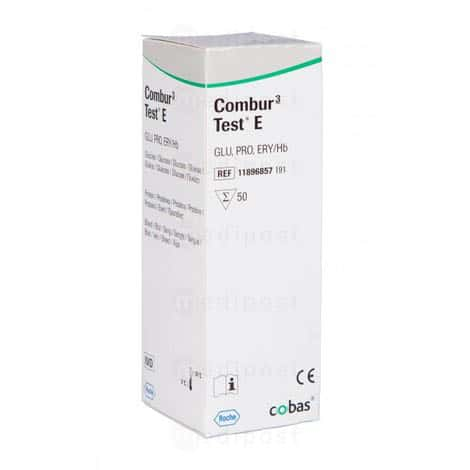
- Combur 3E: Glucose, protein, blood.
- Combur 3: pH, protein, glucose
- Combur 2 LN: leukocytes, nitrites
Packaging:
-
Combur 10: box of 100 test strips
-
Combur 9: box of 50 or 100 test strips
-
Combur 7: box of 100 test strips
-
Combur 6: box of 50 test strips
-
Combur 5: box of 100 test strips
-
Combur 4N: box of 50 test strips
-
Combur 3E: box of 50 test strips
Combur 3: box of 50 test strips
Tests and principles
|
Test kit(s) |
SG | pH | LEU | NIT | PRO | GLU | KET | UBG | BIL | ER-Y | Param. |
|---|---|---|---|---|---|---|---|---|---|---|---|
| Combur 10 | • | • | • | • | • | • | • | • | • | • | 10 |
| Combur 9 | • | • | • | • | • | • | • | • | • | 9 | |
| Combur 7 | • |
• | • | • | • | • | • | 7 | |||
| Combur 6 | • | • | • | • | • | • | 6 | ||||
| Combur 5 | • | • | • | • | • | 5 | |||||
| Combur 4N | • | • | • | • | 4 | ||||||
| Combur 3 | • | • | • | 3 | |||||||
| Combur 3E | • | • | • | 3 | |||||||
| Combur 2LN | • | • | 2 |
Urine specific gravity (SG): The test detects the concentration of ions in urine. It is based on the release of protons which, in the presence of cations, form a complex. The reaction produces a color change of the indicator (bromothymol blue) which changes from blue to bluish-green and then to yellow.
pH: the reactive zone contains three indicators: methyl red, phenolphthalein and bromothymol blue, and reacts specifically with H+ ions.
Leukocytes (LEU): the test highlights the esterase activity of granulocytes. These enzymes hydrolyze an indoxyl ester, leading to the formation of indoxyl which reacts with a diazonium salt to give a purple-colored derivative.
Nitrites (NIT): the test is based on the Griess reaction principle and is specific to nitrites. It detects nitrites, and thus indirectly nitrite-positive germs present in urine, by the pink to red coloration of the reactive zone. Even a pale pink coloration already indicates significant bacteriuria.
Protein (PRO): the test is based on the protein error principle of pH indicators. It is particularly sensitive to albumin.
Glucose (GLU): glucose is detected by the specific glucose oxidase/peroxidase reaction (GOD-POD method).
Ketones (KET): detection is based on the Legal reaction principle. The test reacts more strongly to acetoacetic acid than to acetone.
Urobilinogen (UBG): a stable diazonium salt instantly forms a red azo derivative with urobilinogen. The test is specific to urobilinogen.
Bilirubin (BIL): Detection is based on the coupling of a diazonium salt with bilirubin, thus forming a colored azo derivative. Any pink coloration, even pale, must be interpreted as a positive result and therefore pathological. Other constituents of urine are at the origin of a more or less intense yellow coloration.
Blood (ERY/Hb): Hemoglobin and myoglobin catalyze the oxidation of the indicator by the organic hydroperoxide contained in the reactive zone to give a blue-green coloration.
What is Combur-Test®?
Combur-test is a small piece of paper or plastic impregnated with chemicals that can be used to perform a number of tests on urine. These urine test strips can be used to detect substances such as glucose, blood, protein, nitrite, leukocytes and ketones in urine. Test results can indicate health problems such as diabetes, urinary tract infections and kidney disease.
In which cases should Combur-Test® be used ?
Urine test strips are primarily used to assess the health of the kidneys and urinary tract. They can detect problems such as:
-
Diabetes: Urine test strips can detect high levels of glucose in urine, which may indicate uncontrolled diabetes.
-
Urinary tract infections: Urine test strips can detect high levels of nitrite and leukocytes in urine, which may indicate a urinary tract infection.
-
Kidney disease: Urine test strips can detect high levels of protein in urine, which may indicate kidney disease.
-
Other: Urine test strips can also detect ketones in urine, which may indicate a state of ketosis, a condition in which the body uses fats as a source of energy.
It is important to note that urine test strip results are not always accurate and may require further testing for diagnostic confirmation. It is therefore important to consult a doctor to interpret the results.
Why choose the Combur® brand?
There are many brands of urine test strips on the market, each with its own advantages and disadvantages. It is therefore important to consider several factors before choosing a brand.
The Combur brand is a popular brand of urine test strips used to detect health problems in urine. It is often used by doctors, nurses and patients to perform quick and convenient tests at home.
Combur test strips are easy to use, convenient, and provide fast results. Their packaging is practical and easy to store.
It is important to note that it is important to choose a quality urine test strip, so it is recommended to check the expiration date and follow the instructions for use to obtain reliable results. It is also important to consult a doctor to interpret test results and obtain a definitive diagnosis.
What criteria should be used to choose urine test strips?
There are several criteria to consider when choosing urine test strips:
-
Accuracy of results: It is important to choose urine test strips that provide accurate results to avoid false positives or false negatives. It is recommended to choose urine test strips from a recognized brand and check user reviews.
-
Number of parameters tested: Some urine test strips test only one parameter, while others can test several. If you have specific health concerns, it may be useful to choose urine test strips that test multiple parameters.
-
Ease of use: It is important to choose urine test strips that are easy to use, with clear and simple instructions. Urine test strips that require fewer manipulations to obtain results are more convenient.
-
Storage: It is important to choose urine test strips that are easy to store, and that have a good shelf life.
-
Cost: It is important to consider the cost of urine test strips, as some may be more expensive than others. It is important to find a good balance between cost and quality of urine test strips.