
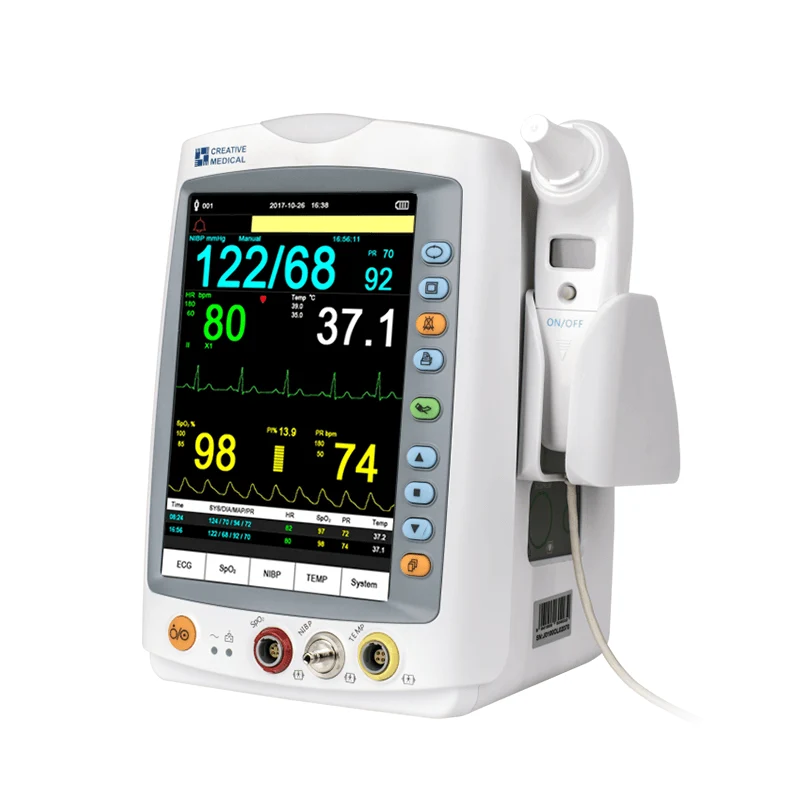






PC-900Plus Vital Signs Monitor 7'' LED screen - SpO2/PR/NIBP/ECG/TEMP(ear) with lateral support thermometer
Référence |
PC900PLUSEAR |
Associated categories: General diagnostic medical equipment > Holters and health monitors > Lepu PC-900Plus vital signs monitor 7'' LED screen - SpO2/PR/NIBP/TEMP/ECG
Key features
- Comprehensive monitoring: SpO2, 3-lead ECG, NIBP, PR, respiratory rate, temperature.
- 7" touchscreen: waveform display + numerical values.
- Large memory: up to 12,000 NIBP recordings and 3,000 SpO2 recordings.
- Actionable data: lists, trend graphs and waveforms.
- Export and updates: USB port.
- Battery life: rechargeable integrated battery > 6 hours.
- Reliable SpO2: Lepu MoveOxy® technology (accurate measurement even in low perfusion).
- Thermometer function (ear) and side support
- Options: integrated thermal printer (optional), trolley (optional).
- Compliance: IEC 60601-1.
Use
Designed for effective vital signs monitoring in various settings (office, clinic, home care), with detailed monitoring through history management and portability.
Package contents
- Patient monitor
- SpO2 finger clip sensor for adults
- Adult NIBP cuff (25–35 cm)
- Skin temperature probe
- Manual
- Power cable
Warranty: 2 years
Technical sheet – Lepu PC-900 Plus
General characteristics
| Monitor dimensions | 160 mm × 160 mm × 235 mm |
|---|---|
| Weight | 3.1 kg |
| Screen | Touchscreen 7 inches, ECG/SpO2 waveform display and numerical values |
| Measured parameters | SpO2, ECG, NIBP, PR, respiratory rate, temperature |
| Memory | Up to 12,000 NIBP recordings; 3,000 SpO2 recordings |
| Visualization | Waveforms, lists, trend graphs |
| Connectivity | USB port (data export and updates) |
| Power supply | AC + rechargeable integrated battery (> 6 hours) |
| SpO2 technology | Lepu MoveOxy® (accurate measurement even in low perfusion) |
| Options | Integrated thermal printer (optional); trolley (optional) |
| Standard | IEC 60601-1 |
NIBP
| Technique | Oscillometric |
|---|---|
| Measurement modes | Manual, Auto, STAT |
| Accuracy | Maximum mean difference: ±5 mmHg; Maximum standard deviation: 8 mmHg |
| Systolic pressure |
Adult: 40–275 mmHg Pediatric: 40–200 mmHg Neonatal: 40–135 mmHg |
| Diastolic pressure |
Adult: 10–210 mmHg Pediatric: 10–150 mmHg Neonatal: 10–95 mmHg |
| Mean arterial pressure |
Adult: 20–230 mmHg Pediatric: 20–165 mmHg Neonatal: 20–110 mmHg |
| Overpressure protection limit |
Adult: 300 mmHg Pediatric: 240 mmHg Neonatal: 150 mmHg |
SpO2 (Blood oxygen saturation)
| Transducer | Dual wavelength LED |
|---|---|
| SpO2 measurement range | 35% – 100% |
| SpO2 accuracy | ±3% for a value between 70% and 100% |
| Low perfusion | Up to 0.4% |
Pulse rate (PR)
| Measurement range | 30 – 240 bpm |
|---|---|
| Accuracy | ±2 bpm or ±2% (whichever is greater) |
3-lead ECG (Electrocardiogram)
| Input dynamic range | ±0.5 mVp to ±5 mVp |
|---|---|
| Measurable heart rate range | 15 – 350 bpm |
| Heart rate accuracy | ±1% or ±2 bpm (whichever is greater) |
| HR alarm delay | ≤ 10 s |
| Sensitivity selection | ×1/4, ×1/2, ×1, ×2 |
| Scroll speed | 25 mm/s |
| ECG noise level | ≤ 30 µV p-p |
Temperature
| Measurement range | 21.0 °C – 50.0 °C |
|---|---|
| Accuracy | ±0.2 °C for the 25 °C – 45 °C range |
Note: Use in accordance with manufacturer's instructions and applicable care protocols.
FAQ (SEO) – Lepu PC-900 Plus
1) What is the Lepu PC-900 Plus monitor used for?
The Lepu PC-900 Plus is used to monitor multiple parameters: SpO2, ECG, non-invasive blood pressure (NIBP), temperature, as well as indicators such as pulse rate and respiratory rate. It is suitable for clinic, office and home care settings.
2) How do I export data from the PC-900 Plus?
The monitor has a USB port allowing you to export data (history and trends) and perform updates. It can store up to 12,000 NIBP recordings and 3,000 SpO2 recordings.
3) Does SpO2 measurement remain reliable in case of low perfusion?
Yes, the PC-900 Plus uses Lepu MoveOxy® technology, designed to improve the accuracy of SpO2 measurement even in low perfusion, to obtain more stable readings in difficult conditions.